Study Plan for the Consecutive Master’s Course of Studies "Computer Science" at the University of Kaiserslautern
from 06. 09. 2023
New in this version:
- Updated modules in the specializations 'Algorithms and Deduction', 'Distributed and Networked systems', 'Embedded Systems and Robotics', 'Software Engineering' and 'Intelligent Systems'.
- New Specialization 'Data Science'
Table of Contents
1. Introduction
2. Objectives of the Course of Studies
3. Study Modules and Types of Impartment of Knowledge
4. Duration and Scope of the Course of Studies
5. Organization of the Course of Studies
6. Master's Examination
7. Study Schedule
7. Study Abroad
Appendix: Study Schedule
Appendix 1. Sections of the Master’s Course of Studies
Appendix 2. Chronological Organization of the Master’s Course of Studies
1. Introduction
This study plan informs on objectives, structure, duration, scope, examinations and the envisaged study modules of the Master’s course of studies "Computer Science". It contains proposals for a purposeful sequence of the study modules. In particular, it regulates the selection options in the fields of specialization representing the focus of studies.
2. Objectives of the Course of Studies
The Master’s course of studies “Computer Science” deepens and extends the technical basis acquired in the Bachelor Course of Studies “Computer Science” in fundamentals, systems, and applications. In particular, this improves the abilities for planning, designing and realization of information systems as well as the professional qualification.
When studying, the impartment and application of deepening knowledge in two larger partial areas of computer science is being focused. Thus, the students are being taught up to the cutting edge of these particular partial areas. The successful Master's degree qualifies the candidates of the course of studies for independent further education as per the state of research in the selected specialization areas. Moreover, they will acquire the necessary skills for independent scientific work.
3. Study Modules and Types of Impartment of Knowledge
Study modules (short: modules) will be offered in the form of courses, recitations, seminars and projects. Courses cover the coherent presentation and impartment of fundamentals, core knowledge, specialized knowledge and concepts of computer science. In recitations, the application of the lecture contents will be taught and trained based on tasks to be solved independently. The aim of a seminar is the handling of a topic of computer science by independent literature studies, the preparation of a final paper, as well as the comprehensible presentation of the topic. In projects, more extensive assignments of computer science will be handled in team work by using the taught methods and techniques.
Course modules get differentiated into theory modules, specialization modules and modules of of supplement section. Theory modules impart deepening theoretical knowledge of general significance and thus must be attended by all students. Specialization modules impart deepening knowledge of a specific area of computer science. Modules in the supplementary block render the acquisition of extended knowledge in particular areas of computer science or in an application area of computer science.
The study modules have a significance according to ECTS credit points, which corresponds to their expenditure in time. One credit point, abbreviated CP, is equivalent to about 30 working hours. Included therein are times to be present as well as times for preparation and after-preparation of the material to be studied, for the solution of exercises, for examination preparation, and for the rendering of examination performances.
4. Duration and Scope of the Course of Studies
The regular study time until the Master's examination amounts to four semesters. The Master's studies comprise modules and the Master’s thesis within an entire scope of 120 ECTS credit points.
5. Organization of the Course of Studies
The Master's studies are divided into several sections (cf. Fig. 1). The sections Computer Science Theory and Formal Fundamentals imparts deepening theoretical knowledge and thus creates important prerequisites for scientific work. While the modules of the section Computer Science Theory are restricted to formal methods of Computer Science, the modules of the section Formal Fundamentals may include other basics of mathematics/sciences which are essential in a specialization of application field of Computer Science.
In the focus of the master's studies are two specialization areas to be chosen by the student from the existing offer, which imparts extensive deepening knowledge in a larger partial area of computer science, each. One of the two specialization sections includes one project module, and one seminar module.
The supplement section includes further computer science modules from any deepening fields and/or modules from other courses of studies to emphasize the application of computer science. The choice the modules in the supplementary block must be approved by the examination board or an authorized advisor.
In the sections 'Computer Science Theory', 'Formal Fundamentals', 'Specialization 1', 'Specialization 2' and 'Supplementary Block' of the Master's programme, successfully examined modules at Master's level of at least 56 credits are required.
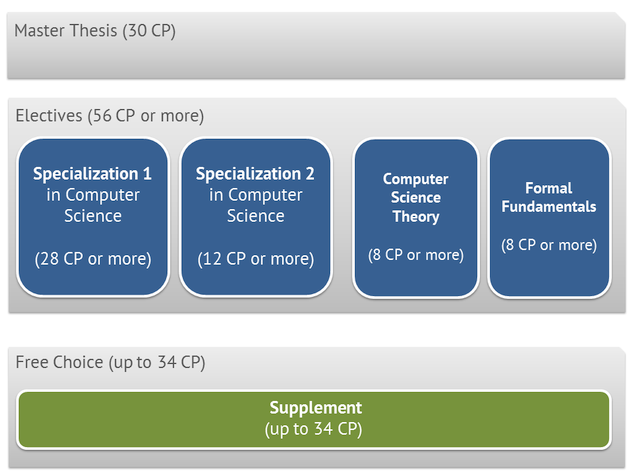
Fig. 1: Conception of the Master’s Course of Studies „Computer Science“
6. Master's Examination
The Master's exam is composed of the study-accompanying module exams and the Master's thesis. A module examination basically consists of one exam extending to the study material of the module. It may assume the rendering of study performances. For every module of the Master's course of studies, within one year two examination dates will be offered. Seminars are being assessed based on the final paper, the oral presentation and the participation in the discussion, projects due to prepared solutions and on attestations. The Master's thesis includes the result, the preparation and the final colloquium.
7. Study Schedule
The study schedule (cf. Appendix) gives information on the study modules (name, hours per semester, ECTS credit points), their allocation to the sections (cf. 5) and the selection options. Moreover, it comprises recommendations for a proper organization of the course of studies. The schedule is part of this study plan. Alterations are decided by the department council and must be published via the web-pages of the department.
7. Study Abroad
The world is getting closer together, especially in computer science. Many leading research institutions are located abroad. All major computer science companies act global and have customers in many countries. The research groups of the Computer Science department are also networked with international partners. Therefore, we encourage our students to spend part of their studies abroad.
In addition to an individually organized stay, students of the Department of Computer Science will also have the opportunity to go through scholarships. The Socrates/Erasmus programme offers the opportunity to study at low cost in other European countries, as there are no tuition fees at the partner university. The research groups of the Department of Computer Science have a multitude of individual cooperation partners who also support a study abroad. Further information on studying abroad is offered by the International Department of TUK.
Mobility Window
Typically, master students go abroad in the first three semesters, but the master thesis in the fourth semester can also be supervised by a professor in the department. There is no fixed semester for your studies abroad.
The best period for studying abroad depends greatly on the individual course of study. For example, the master project requires prior knowledge from advanced lectures. If these cannot be acquired in the course of studying abroad, it should be ensured that both the master lecture and the project are completed at TUK. On the other hand, the large supplementary block of the master's programme helps you to complete a study abroad without having to look for certain substitute lectures. Courses can be chosen very flexible according to your interests.
Even if you have a holiday semester for your studies abroad, examinations can be carried out abroad (however, during a holiday semester no examinations can be filed at the TU Kaiserslautern). Even the first master semester can be a holiday semester if it is spent abroad. However, it is important to note that the lecture times are different in many countries than in Germany and there might be overlapping exam phases which force you to keep enrolled regularly at TUK.
Planning a stay abroad should begin approximately one year before the scheduled departure. The first steps should be an appointment with the study advisory service by the faculty and with the Department for International Affairs of TUK. As soon as you have decided where to go, your stay abroad should be discussed with your mentor to modify your Examination Plan if necessary. A so-called "learning agreement" must then be created. This is a list of courses to be completed at the host university. The document must be signed by both the host University and the Chairman of the (Master) Examination Committee for later recognition.
Appendix: Study Schedule
Appendix 1. Sections of the Master’s Course of Studies
Computer Science Theory
This mandatory section includes one or two theoretical module(s) in the scope of at least 8 ECTS-CP from following list:
- MAT-52-11-M-7 "Graphs and Algorithms" (4V+2U; 9.0CP; EN)
- INF-36-52-M-6 "Verified Functional Programming" (4V+2U; 8.0CP; EN)
- INF-56-51-M-6 "Concurrency Theory" (4V+2U; 8.0CP; EN)
- INF-56-52-M-6 "Advanced Automata Theory" (4V+2U; 8.0CP; EN)
- INF-56-53-M-5 "Complexity Theory" (4V+2U; 8.0CP; EN)
- INF-59-51-M-5 "Automated Reasoning" (4V+2U; 8.0CP; EN)
- INF-62-52-M-6 "Verification of Reactive Systems" (4V+2U; 8.0CP; EN)
- INF-75-50-M-5 "Machine Learning I - Theoretical Foundations" (4V+2U; 8.0CP; EN)
Formal Fundamentals
This mandatory section includes one or two formal module(s) in the scope of at least 8 ECTS-CP from following list (this can be lectures from Computer Science Theory but also formal fundamentals of other departments:
Subject "Computer Science Theory"- INF-36-52-M-6 "Verified Functional Programming" (4V+2U; 8.0CP; EN)
- INF-56-51-M-6 "Concurrency Theory" (4V+2U; 8.0CP; EN)
- INF-56-52-M-6 "Advanced Automata Theory" (4V+2U; 8.0CP; EN)
- INF-56-53-M-5 "Complexity Theory" (4V+2U; 8.0CP; EN)
- INF-59-51-M-5 "Automated Reasoning" (4V+2U; 8.0CP; EN)
- INF-62-52-M-6 "Verification of Reactive Systems" (4V+2U; 8.0CP; EN)
- INF-75-50-M-5 "Machine Learning I - Theoretical Foundations" (4V+2U; 8.0CP; EN)
- MAT-14-12-K-3 "Introduction to Symbolic Computing" (4V+2U; 9.0CP; DE)
- MAT-40-11-M-4 "Commutative Algebra" (4V+2U; 9.0CP; EN)
- MAT-40-14-M-4 "Cryptography" (4V+2U; 9.0CP; EN)
- MAT-40-28-M-4 "Plane Algebraic Curves" (2V+1U; 4.5CP; EN)
- MAT-40-29-M-4 "Quadratic Number Fields" (2V+1U; 4.5CP; EN)
- MAT-50-11-M-4 "Integer Programming: Polyhedral Theory and Algorithms" (4V+2U; 9.0CP; EN)
- MAT-50-12-M-4 "Nonlinear Optimization" (4V+2U; 9.0CP; EN)
- MAT-52-12-M-7 "Advanced Network Flows and Selfish Routing" (4V+2U; 9.0CP; EN)
- MAT-59-11-M-7 "Theory of Scheduling Problems" (4V+2U; 9.0CP; EN)
- MAT-52-11-M-7 "Graphs and Algorithms" (4V+2U; 9.0CP; EN)
- MAT-51-13-M-7 "Multicriteria Optimization" (4V+2U; 9.0CP; EN)
- MAT-60-12-M-4 "Regression and Time Series Analysis" (4V+2U; 9.0CP; EN)
- MAT-60-14-M-6 "Monte Carlo Algorithms" (4V+2U; 9.0CP; EN)
- MAT-80-11-M-4 "Differential Equations: Numerics of ODE & Introduction to PDE" (*; 9.0CP; EN)
- MAT-80-12A-M-4 "Introduction to Systems and Control Theory" (2V+1U; 4.5CP; EN)
- MAT-80-17-M-6 "Dynamical Systems" (2V+1U; 4.5CP; EN)
- EIT-LRS-504-M-3 "Linear Control" (3V+1U; 5.0CP; DE)
- MV-TM-136-M-4 "Finite Elements" (3V+1U; 6.0CP; DE)
Specialization 1
In the specialization, students gain in-depth knowledge in a specific field of computer science, enabling them to comprehend and contribute to the state-of-the-art of research in the field. The specialization consists of a set of lectures, at least one seminar and at least one project matching the specialization field. Successfully examined modules of at least 16 credits are required. If the specialization "Data Science" is chosen in section "Specialization 1", modules in all subsections must be completed to the minimum extent specified in order to successfully complete the section "Specialization 1". The Computer Science Department offers the following fields of specialization, which are also described further in Appendix 3:
- Algorithms and Deduction
- Embedded Systems
- Information Systems
- Intelligent Systems
- Distributed and Networked systems
- Software Engineering
- Visualization and Scientific Computing
- Data Science
Specialization 2
This specialization follows the same goals as specialization 1. Moreover, the minimum number of credits to be obtained in this specialization is smaller than for specialization 1. Seminars and projects may also be chosen in specialization 2. Successfully examined modules of at least 12 credits are required. The fields of specialization and their lectures are (if not already taken in specialization 1):
- Algorithms and Deduction
- Embedded Systems
- Information Systems
- Intelligent Systems
- Distributed and Networked systems
- Software Engineering
- Visualization and Scientific Computing
Supplementary Block
The supplementary block has to be planned in consultation with the student’s mentor (a professor of the Computer Science Department assigned by the examination board). The examination plan for the supplementary block can be planned according to the following goals:
- Broadening the computer science study profile by choosing additional modules from arbitrary specializations other than the chosen specializations 1 and 2.
- Strengthening the study profile in a specific application area by choosing modules from study programs of other departments.
Up to 8 credits can be used for electing modules that help develop interdisciplinary skills (personal development, social/ethical aspects of CS, language skills, etc.).
If modules from study programs of other departments are chosen, then at most 10 credits can be obtained by modules from bachelor programs.
In the supplement, further projects or a guided research module can be placed (but only those that are not assigned to one of the chosen specializations). Prerequisite: in the sections 'CS Theory', 'Formal Foundations', 'Specialization 1', 'Specialization 2' and 'Supplement' of the Master's programme, examination achievements for modules at Master's level totalling at least 56 LP are completed.
Mentor approval is required for the Supplementary Block section of the examination plan.
Guided Research
Highly qualified students who are interested in research assign guided research work (incl. scientific publication) to the supplementary block. Prerequisite for exchanging modules is a recommendation of a professor who is willing to advice the research work.
Master's Thesis
The Master's thesis as a highly individual scientific work is t be finished at the End of the Master studies.
- INF-81-11-M-7 "Master's Thesis" (15L; 30.0CP; DE/EN)
Appendix 2. Chronological Organization of the Master’s Course of Studies
| Semester | Computer Science Theory / Formal Fundamentals | Specialization 1 | Specialization 2 | Supplementary Block | ECTS-CP |
|
One theory module from attachment 1. |
Specialization modules (lectures of 16 cp in total) | Specialization modules (lectures of 12 cp in total) |
Optional modules in overall scope of 34 cp. |
approx. 30CP | |
|
One formal fundamental module from attachment 1. |
approx. 30CP | ||||
|
One seminar (4 cp) and one project (8 cp). |
approx. 30CP | ||||
| INF-81-11-M-7 "Master's Thesis" (15L; 30.0CP; DE/EN) | 30CP | ||||
| ECTS-CP | 16 | 28 | 12 | 34 | 120 |
Appendix 3. Specializations
The sections "Specialization 1" and "Specialization 2" of the study program aim at providing comprehensive, in-depth knowledge in specific fields of Computer Science. The Department of Computer Science offers the following specializations, from which two have to be selected. For each specialization, lecture modules have to be elected (a minimum of 16 credits for specialization 1 and a minimum of 12 credits for specialization 2). Moreover, a project (8 credits) and a seminar (4 credits) have to be elected in specialization 1. The subsequent specialization descriptions list the offered modules and additional regulations for the election options.
Each specialization description has a number of sections or parts and an indication if a part is mandatory. Each part or section contains a list of modules and may indicate mandatory modules if a part is elected. It may also define restrictions regarding the minimum number of credits that have to be elected for a section or part.
| Algorithms and Deduction | |
|---|---|
| Responsible person | Prof. Anthony Lin |
| Educational objectives |
In algorithmics one tries to find efficient algorithmic solutions to problems from all areas of
computer science. Therefore, knowledge from this specialization can be applied to a wide range of topics.
Besides designing smart algorithms or data structures one aims to prove their efficiency and correctness
and investigates the structural complexity of the problems considered. |
| Part Foundations | Choice of:
|
| Part Algorithms | Choice of:
|
| Part Program Semantics and Deduction |
|
| Part Guided Research (cf. Appendix 1) |
|
| Project modules | Choice of:
|
| Seminar modules | Choice of:
|
| Embedded Systems and Robotics | |
|---|---|
| Responsible person | Prof. Klaus Schneider |
| Educational objectives |
Embedded systems are information processing hardware and software systems which are integral part of complex technical systems. There, they realize all central control functions and/or they process continuous data streams in real-time. They are used in almost all industrial products and determine increasingly the characteristics of those products. Due to the integration of many subsystems they often become very complex. Beyond that, many embedded systems are part of safety-critical installations. Embedded systems are needed in different applications and many variants so that they do not allow uniform solutions. In this specialization, students will learn the systematic development of embedded systems. Depending on the choice from the offered lectures the focus can be shifted toward software engineering for embedded systems, toward developing the hardware platform of embedded systems, or toward developing individual applications (in our case robotics). Knowledge of the behaviour of the enclosing technical system is obtained by the courses of the minor subject. These are essential for understanding the behaviour of embedded systems and with that for their development, too. |
| Part Foundations | Choice of:
|
| Part Robotics | Choice of:
|
| Part Model-Based Design | Choice of:
|
| Part System Architecture | Choice of:
|
| Part Guided Research (cf. Appendix 1) |
|
| Project modules | Choice of:
|
| Seminar modules | Choice of:
|
| Information Systems | |
|---|---|
| Responsible person | Prof. Stefan Deßloch |
| Educational objectives | This specialization block gives students the opportunity to deepen their knowledge of information systems, and obtain specialized skills in these areas. |
| Part Foundations | Modules:
|
| Part Distributed Information Systems | Choice of:
|
| Part Modelling, Search and Mining | Choice of:
|
| Part Guided Research (cf. Appendix 1) |
|
| Project modules |
Choice of:
|
| Seminar modules |
|
| Intelligent Systems | |
|---|---|
| Responsible person | Prof. Marius Kloft |
| Educational objectives |
Intelligent Systems (IS) is an area of computer science that deals with making computers behave "intelligently": computers that understand images, speech, and texts, software that reasons, plans, and makes autonomous decisions; systems that interpret sensor data and user behaviour and communicate and collaborate with users. IS furnishes the technologies underlying many of the fastest-growing application areas, like Internet search, computer gaming, social computing, e-commerce, electronic trading, smart homes, data mining, digital libraries, and intelligent user interfaces. The Intelligent Systems specialization prepares students for advanced development and academic research in areas of artificial intelligence, machine learning, pattern recognition, and computer vision. The course of study combines rigorous theoretical foundations with practical applications. Students have ample opportunities for research in several large and active research groups within the intelligent systems area and at the German Research Center for Artificial Intelligence (DFKI). Students interested in specializing in Intelligent Systems should have a good working knowledge of algorithms, complexity theory, and software development, and an interest in discrete mathematics, analysis, and stochastics. |
| Part Foundations | Choice of:
|
| Part Models of Complex Systems | Choice of:
|
| Part Data Analysis and Mining | Choice of:
|
| Part Guided Research (cf. Appendix 1) |
|
| Project modules | Choice of:
|
| Seminar modules | Choice of:
|
| Distributed and Networked systems | |
|---|---|
| Responsible person | Prof. Jens Schmitt |
| Educational objectives | This specialization prepares students to acquire in-depth knowledge and skills in the field of distributed and networked systems, according to the state of practice and research in this field. The focus is on engineering communication protocols as well as the performance analysis of distributed systems and the provision of security in networks. Modules of the specialization cover knowledge of specialized algorithms and protocols for wired and wireless networks, including core technologies, quality of service protocols, time synchronization, duty cycling, deterministic arbitration and routing. In the area of performance analysis, students acquire the ability to model complex networked and distributed systems with the aid of the so-called network calculus. The specialization block also contains modules related to security in networks, knowledge about possible attacks as well as security measures and defence strategies. This knowledge is practically applied in exercises and project modules to acquire the skills needed to develop and evaluate distributed and networked systems. |
| Part Foundations | Choice of:
|
| Performance and Security Analysis | Choice of:
|
| Part Guided Research (cf. Appendix 1) |
|
| Project modules |
Choice of:
|
| Seminar modules |
Choice of:
|
| Software-Engineering | |
|---|---|
| Responsible person | Prof. Peter Liggesmeyer |
| Educational objectives |
Students learn the technical and theoretical foundations of software engineering, which are used during the development, distribution and application of software systems. Students acquire skills that prepare them to grow into management positions - typically as system architects, project managers or quality managers. Therefore, the division of project management processes play an important role. In addition to in-depth knowledge of software engineering, models and tools for the development and maintenance of software systems are taught. The focus is on modern programming languages and language concepts as well as the verification of programs. The research-oriented approach enables the students to specialize in scientific topics. |
| Part Foundations | Choice of:
|
| Part Software Processes | Choice of:
|
| Part Safe and Dependable Systems | Choice of:
|
| Part Programming Methodology and Languages | Choice of:
|
| Part Guided Research (cf. Appendix 1) |
|
| Project modules |
|
| Seminar modules |
|
| Visualization and Scientific Computing | |
|---|---|
| Responsible person | Prof. Christoph Garth |
| Educational objectives | The discipline of Scientific Computing focuses on the construction of simulation models, analysis, and design techniques that are employed in a rapidly increasing fashion in the computer-based solution of scientific, technical, and design problems. The specialization “Visualization and Scientific Computing” allows students to familiarize themselves with problems and techniques of Scientific Computing and advance their knowledge in this area up to the state of the art. The three focus areas Geometric Modelling, Optimization, and Visualization are augmented by fundamental knowledge in Computer Graphics. The specialization is supported by a wide variety of minor subjects that illustrate possible applications of Scientific Computing and augment the Computer Science curriculum. The choice of minor should be matched to the chosen topics in Computer Science. |
| Part Foundations | Choice of:
|
| Part Geometric Modelling | Choice of:
|
| Part Scientific Visualization | Choice of:
|
| Part Scientific Computing | Choice of:
|
| Part High-Performance Computing | Choice of:
|
| Part Guided Research (cf. Appendix 1) |
|
| Project modules | Choice of:
|
| Seminar modules | Choice of:
|
| Data Science | |
|---|---|
| Responsible person | Prof. Christoph Garth |
| Educational objectives |
This specialization aims to provide students with in-depth knowledge and skills that reflect the current state of practice and research in the field of Data Science. A main focus is on mastering advanced methods of data processing and analysis. This includes, among other topics, efficient database management and querying. Students discover advanced techniques in Machine Learning and Data Analytics, where they learn how to extract relevant information and patterns from complex data sets to gain valuable insights. This includes statistical analysis, exploratory data analysis and advanced data mining methods. Students are enabled to make data-based decisions in various application areas. Students also acquire the ability to present data in a visually appealing way and thus communicate findings in an understandable way. The specialization area Data Science therefore qualifies graduates who are able to tackle complex data-based challenges in diverse fields of application and develop innovative solutions. |
| Part Machine Learning and Data Analytics | Choice of (≥ 8 ECTS):
|
| Visualization | Choice of (≥ 4 ECTS):
|
| Part Database Systems and Data Mining | Choice of (≥ 4 ECTS):
|
| Part Guided Research (cf. Appendix 1) |
|
| Project modules | Choice of:
|
| Seminar modules | Choice of:
|